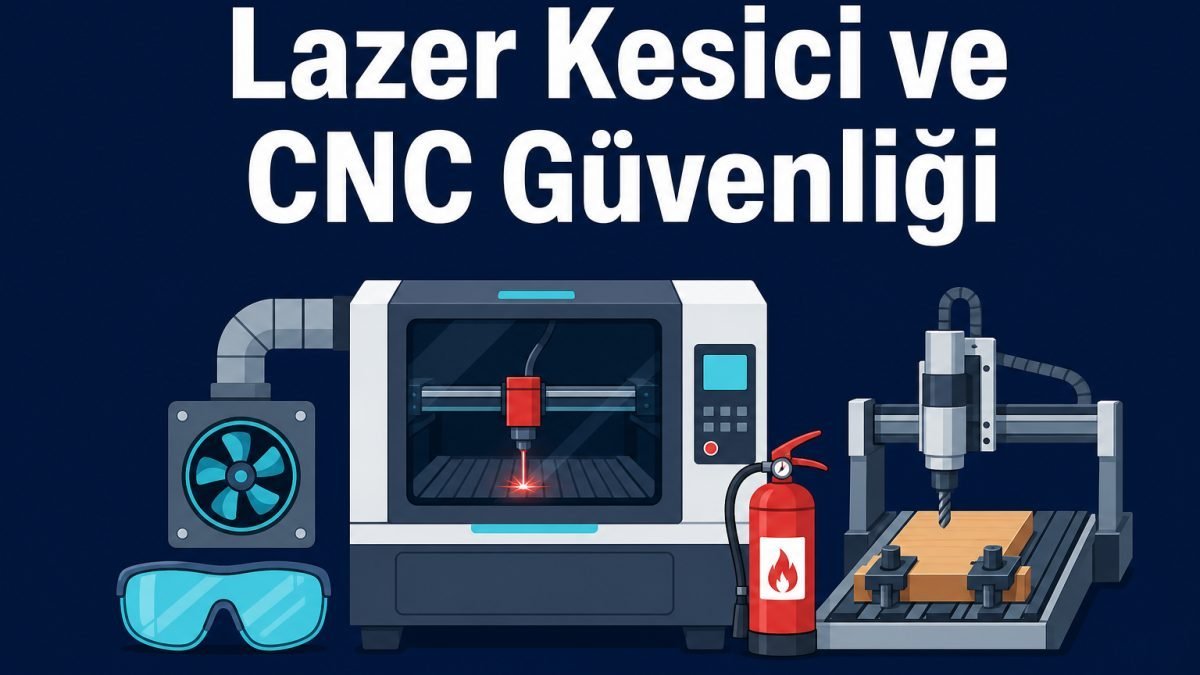
A laser cutter and a CNC router are very useful for making models, gears, posters, and cases. But these two machines are among the highest-risk equipment in a school workshop: an invisible beam, toxic fumes, fire, and a broken bit. This article is the fifth part of our workshop safety series. This content is for informational purposes only and does not replace official procedures, equipment manuals, or authorized instructions.
Golden rule: A laser cutter and CNC are operated only under the supervision of a trained adult. A student cannot start the machine alone or change the material alone.
Main risks with a laser cutter
- Eye injury: A reflected beam can cause permanent damage.
- Fire: Flames can appear during cutting.
- Toxic fumes: Some materials release harmful gases when burned.
- Burns: The edge of a freshly cut piece is hot.
Materials that must never be cut
| Material | Why is it banned? |
|---|---|
| PVC / vinyl | Releases chlorine-containing gas; harms both health and the machine |
| Polycarbonate (PC) | Does not cut well, yellows, can catch fire |
| Mirror, metal, reflective surface | Reflects the beam back; damages the machine and the eye |
| Carbon fiber, composites | Harmful dust and gas |
| Unknown foam / sponge | Catches fire fast and gives off toxic fumes |
If you are not sure what the material is, do not cut it. "It looks like plastic" is not enough information.
Laser cutting steps
- The teacher turns the machine on and starts the extractor.
- The material type is approved and placed flat.
- Focus is set; the lid is closed.
- The job starts; nobody leaves the machine unattended.
- When cutting ends, wait until the smoke clears, then open the lid.
- Remove the part after it cools; collect scrap pieces.
Lid, goggles, and interlock
- If the lid is not closed, the machine must not run (interlock). Never disable this safety.
- Do not open the lid to watch the cut; watch through the glass.
- On open-frame lasers, wavelength-rated protective goggles are required. Sunglasses do not work.
- Do not try to film a close-up video from inside with a phone.
Be ready for fire
Seeing a flame while working with a laser is a real possibility. Be prepared:
- Keep a suitable extinguisher and a fire blanket next to the machine.
- If flaming continues, stop the job; cut the power.
- A small flame is put out by the teacher; the student moves away.
- Clean leftover pieces from the cutting bed regularly.
- Do not run the machine if the exhaust filter is clogged; smoke stays inside.
CNC router and milling
On a CNC, unlike a laser, the risk is mechanical: a spinning bit, flying pieces, and dust.
- The workpiece must be firmly fixed.
- Goggles are required; a mask is recommended for dust.
- Long hair is tied back; loose clothes and hooded cords are not worn; gloves are not worn (they can catch on the spinning bit).
- Do not reach onto the table while it is running; do not sweep chips by hand.
- Everyone must know where the emergency stop button is.
- Bit changes and zeroing are the teacher's job.
- When the job ends, stop the machine and collect chips with a brush / extractor.
Common mistakes
- "Just let me look once" and opening the lid: The beam and smoke come out at once.
- Loading material without knowing it: One PVC cut affects the whole class.
- Turning off the exhaust to reduce noise: The smoke goes into your lungs.
- Holding a CNC part with tape only: A loose part can fly like a projectile.
- Leaving the machine alone: If a flame is not noticed, a fire grows.
If there is an injury or incident
- Stop the machine with emergency stop or the main switch.
- If smoke bothers you, go to fresh air and tell the teacher.
- If you suspect eye contact, tell the teacher without rubbing the eye; if vision is affected, go to a health facility.
- For a burn, apply cool running water for at least 10 minutes.
- If the flame grows, evacuate; call emergency services and follow school procedure.
Quick checklist
- Is an authorized adult present?
- Is the material approved and safe?
- Is the exhaust / extractor running?
- Is the lid closed and the interlock active?
- Is the extinguisher within reach?
- On CNC: is the part fixed, are goggles on, are gloves off?
- After the job: is the machine off and the area clean?
Related reading
In our series, the articles "3D Printer Safety" and "Safe Work with Hand Tools and Power Tools" complete this topic. In the next part we will talk about moving parts and robot-test safety.
These machines are not toys. Used by the rules they are huge production power; without the rules they mean a serious accident.