Model glue, cyanoacrylate (super glue), epoxy, spray paint, thinner, isopropyl alcohol... These are the materials most often underestimated in the workshop. Yet a small tube of glue can stick fingers together in a second; spray paint in a closed room can make you dizzy. This article is the seventh part of our workshop safety series. This content is for informational purposes only and does not replace official procedures, user manuals, or authorized instructions.
Golden rule: Do not use a chemical whose label you have not read. Do not try to smell it, do not pour it into a food container, and do not mix two unknowns.
Learn to read the label
The warning symbols on the boxes (GHS pictograms) tell you what to do.
| Symbol | Meaning | What to do |
|---|---|---|
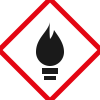 Flame |
Easily flammable | Keep away from soldering irons, heaters, and sparks |
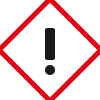 Exclamation |
Irritant | Wear gloves; keep off skin |
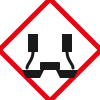 Corrosive |
Burns skin / eyes | Goggles and gloves required |
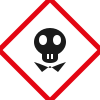 Skull |
Toxic | Students do not use it; teacher decides |
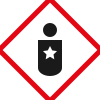 Health hazard |
Breathing risk | Ventilation and a mask |
Common materials and their rules
Cyanoacrylate (super glue)
- It bonds skin to skin in seconds. If fingers stick, do not pull; rub gently in warm soapy water and tell the teacher.
- If it gets in the eye, never rub; rinse with plenty of water and seek medical help at once.
- It can react with cotton and cloth and heat up; do not use it on a cotton cloth.
- Do not point the tube at your face; a clogged tip can spray under pressure.
Epoxy (two-part)
- The mix heats up; do not mix a large amount in one go.
- Wear gloves; uncured resin can sensitize the skin.
- Keep the mixing stick and cup separate; do not use a food container.
Spray paint and varnish
- Use only outdoors or in a spray booth. Do not spray in the middle of the classroom.
- Wear a mask and goggles; check the wind direction.
- The can is pressurized: do not heat, puncture, or throw it into a fire.
- Do not bring a freshly painted part into class before it dries; the smell lasts a long time.
Thinner, acetone, isopropyl alcohol
- All are easily flammable. Do not leave them open next to a soldering station.
- For circuit cleaning, use a small amount poured onto a cloth.
- Do not leave the cap open; the vapour is heavy and spreads across the table.
- It can dissolve plastic cases; test first in a hidden corner.
Ventilation: the simplest protection
- Open a window or turn on the extractor.
- Do not lean your face over the work; vapour rises.
- If you feel a headache, nausea, or a burning throat, stop at once and go to fresh air.
- Saying "I got used to the smell" is not protection; getting used to it does not reduce the risk.
Storage rules
- Chemicals stay in their own labelled containers and in a separate cupboard.
- Never pour them into a water bottle, juice carton, or an unnamed container.
- Flammables go on a shelf away from heaters, soldering irons, and 3D printers.
- The cupboard stays locked; the key stays with the teacher.
- Heavy and large containers go on the bottom shelf.
- Do not use a product that is past its life or has a damaged container.
Spills and contact
- If it spills: Keep people away first and call the teacher. Do not try to wipe it alone.
- On skin: Wash with plenty of water and soap; if redness continues, get medical help.
- In the eye: Rinse with plenty of water for at least 15 minutes without rubbing; remove contact lenses. Tell the teacher and call emergency services.
- Swallowing / inhaling vapour: Do not make the person vomit; take the package with you and call emergency services.
- If it catches fire: Use a suitable extinguisher, not water; clear the area.
Waste: not in the normal bin
- Empty spray cans, paint residue, and thinner rags do not go in the normal bin.
- Cloths soaked with chemical can heat by themselves; collect them in a metal container with a lid.
- Ask your teacher about the school waste procedure; if you do not know, collect it and do not carry it yourself.
- Resin and epoxy leftovers are treated as solid waste after they cure.
Quick checklist
- Did I read the label and warning symbols?
- Do I have teacher approval?
- Is ventilation on?
- Do I need gloves / goggles / a mask, and did I put them on?
- Is flammable material away from hot tools?
- Did I close the container and put it in the labelled cupboard?
- Did I leave the waste in the right place?
Related reading
For the hot glue gun and soldering, see "Safe Work with Hand Tools and Power Tools" in our series; for general rules, see "Workshop Safety: Basic Rules". In the next part we will cover fire safety and evacuation.
There is no rush with chemicals. Read the label, open the air, put on gloves; then work.